
Tooth pain that throbs, worsens with hot or cold food, or keeps you up at night is often a sign of infection deep inside the tooth. The good news: in most cases, the tooth doesn’t have to be extracted. Root canal treatment in Adyar can eliminate the infection, relieve the pain, and save your natural tooth — often in just one or two visits. Here’s everything you need to know, and why Dent Eazee Dental Clinic is trusted as the best dental clinic in Adyar for root canal therapy, painless RCT, and tooth-saving treatment.
What Is a Root Canal, Really?
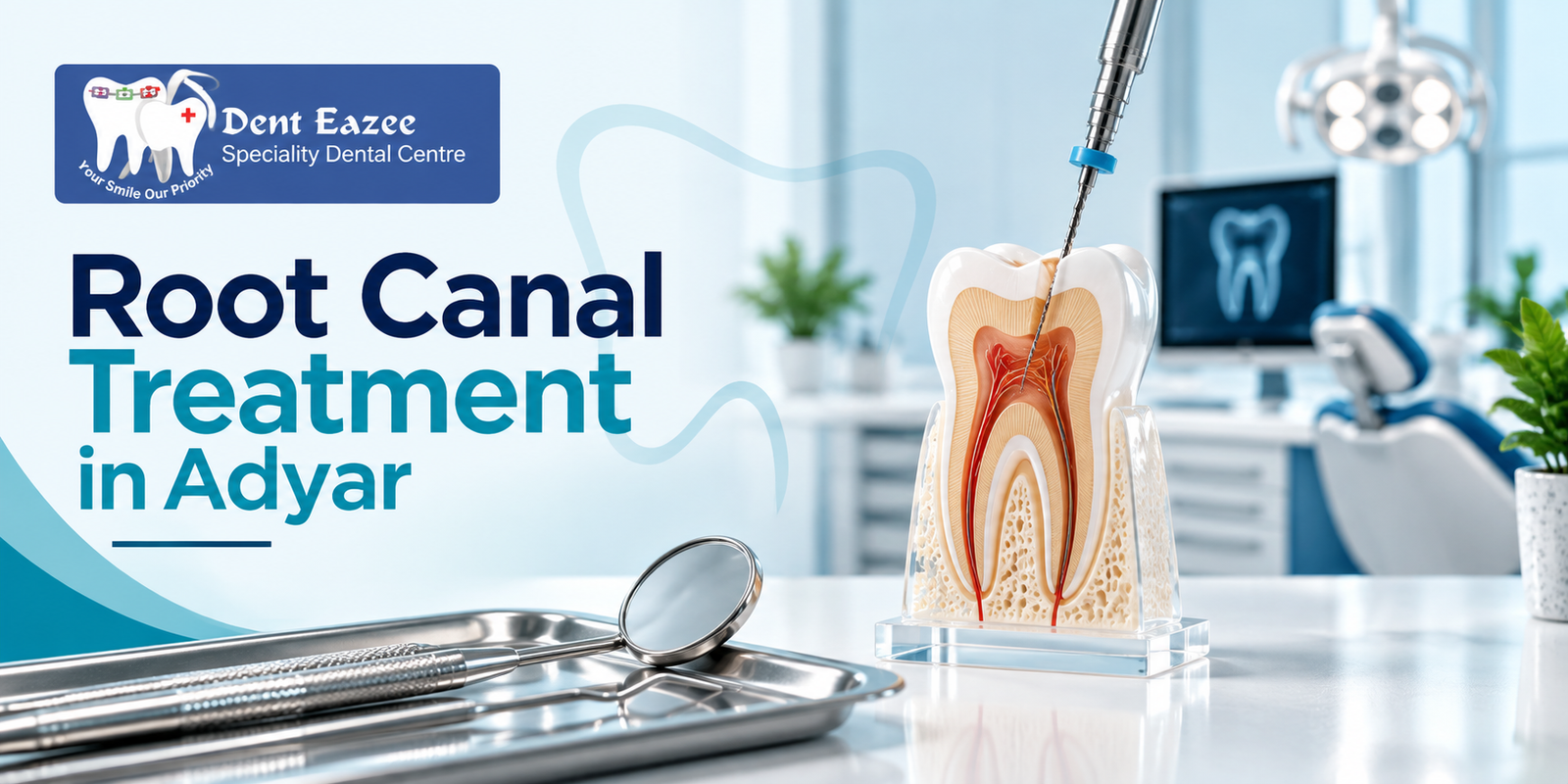
Inside every tooth, beneath the hard enamel and dentin, sits the pulp — soft tissue containing nerves and blood vessels. When decay, a crack, or repeated dental procedures let bacteria reach this pulp, it becomes infected and inflamed. Root canal treatment removes that infected pulp, disinfects the canal, and seals it — preserving the outer tooth structure instead of pulling it out entirely.
As Dr. M. Phani Babu, founder of Dent Eazee, explains to patients considering treatment: root canal therapy is a crucial procedure for saving severely infected or decayed teeth, relieving pain while preserving the natural smile.
Signs You Might Need a Root Canal
Common warning signs that a tooth’s pulp may be infected include:
- Persistent or throbbing tooth pain, especially when chewing
- Prolonged sensitivity to hot or cold that lingers after the stimulus is removed
- Swelling or tenderness in the gums near a specific tooth
- A small pimple-like bump on the gum (a sign of a dental abscess)
- Darkening or discoloration of the tooth
- Pain that suddenly stops (which can mean the nerve has died — not a sign to ignore)
If any of these sound familiar, don’t wait — early evaluation with digital X-rays makes treatment simpler and more predictable.
Is a Root Canal Painful? (The Honest Answer)
This is the question almost every patient asks, and it’s worth answering directly: modern root canal treatment, performed under local anesthesia with proper technique, is not the painful ordeal its reputation suggests. Most patients describe the sensation as similar to getting a filling. The pain people fear usually comes before treatment, from the infection itself — the procedure is what relieves it. For especially anxious patients, sedation dentistry in Adyar is also available to keep the experience relaxed from start to finish.
The Root Canal Procedure, Step by Step
- Examination & Digital X-ray — to assess the shape of the root canals and confirm the extent of infection.
- Anesthesia — local anesthesia numbs the area completely before any work begins.
- Access & Pulpectomy — the dentist opens the tooth and removes the infected pulp tissue.
- Cleaning & Shaping — the canals are thoroughly cleaned, disinfected, and shaped to receive the filling material.
- Filling & Sealing — the canals are filled with a biocompatible material and sealed to prevent reinfection.
- Crown Placement — a dental crown is often placed afterward to restore strength and protect the treated tooth long-term, especially for back teeth that handle heavy chewing forces.
Root Canal vs. Tooth Extraction
It’s natural to wonder whether it’s simpler to just remove a badly infected tooth. In almost every case, saving the natural tooth is the better long-term choice:
- Preserves your natural bite — nothing replicates your natural tooth’s function as well as the original tooth.
- Prevents shifting — extraction leaves a gap that neighboring teeth can drift into over time.
- Protects jawbone health — like any missing tooth, an extraction site can lead to bone loss without replacement.
- Avoids extra cost — replacing an extracted tooth with a dental implant or bridge is typically more involved and costly than a root canal plus crown.
Root Canals and Your Overall Health
Emerging research suggests dental infections don’t just affect your mouth. Chronic oral infections have been linked to broader health risks, including cardiovascular issues and complications for patients managing diabetes. Timely root canal treatment removes the bacterial source of infection, supporting whole-body health — not just a pain-free tooth. This is one more reason Dent Eazee encourages patients not to delay treatment once symptoms appear.
Root Canals for Front Teeth (Lateral Incisors)
Root canal treatment isn’t limited to molars. Front teeth, including the lateral incisors, can also become infected from trauma, deep decay, or cracks — and because they’re so visible when you smile, treating them carefully matters both functionally and cosmetically. Dr. Phani Babu has particular experience managing these more delicate anterior cases, often coordinating with cosmetic dentistry afterward to ensure the restored tooth blends seamlessly with the rest of your smile.
Aftercare Following Root Canal Treatment
Recovery from a root canal is usually straightforward:
- Take any prescribed pain medication as directed.
- Avoid chewing on the treated side until your permanent crown or filling is placed.
- Maintain regular brushing and flossing, gently around the treated area at first.
- Watch for unusual swelling, prolonged pain, or a bad taste — and contact your dentist if these occur.
- Attend your follow-up visit for the permanent crown; delaying this step risks fracturing the weakened tooth.
- Keep up with routine check-ups so your dentist can monitor long-term healing.
When a Root Canal Isn’t Enough
Occasionally, a tooth is too badly damaged or fractured for a root canal to save it. In these cases, your dentist may discuss options like wisdom tooth removal (if the affected tooth is a third molar), or replacement with a dental implant or dentures depending on how many teeth are affected. For patients with multiple compromised teeth, a coordinated full mouth rehabilitation plan may be the most efficient path forward.
Why Choose Dent Eazee for Root Canal Treatment in Adyar
Extensive experience. Dr. M. Phani Babu brings over 18 years of clinical experience to every root canal procedure, giving patients confidence that even complex cases are in capable hands.
Advanced technology. Dent Eazee uses cutting-edge diagnostic and treatment technology to enhance the accuracy, efficiency, and comfort of every root canal.
Comprehensive, comfortable care. From diagnosis through to crown placement, treatment is handled under one roof, minimizing the number of separate appointments and referrals.
Preventive philosophy. The clinic emphasizes catching problems early through regular check-ups, reducing the chances that a minor cavity ever progresses into a root canal emergency in the first place.
Genuine patient trust. With a 4.9-star Google rating and years of consistent care, Dent Eazee has earned its place as the best dental clinic in Adyar for restorative and emergency dental treatment.
To see the difference firsthand, browse the clinic’s photo gallery and video library, read patient stories on the testimonials page, check the media page for press coverage, or explore related reading on the Dent Eazee blog — including deeper dives into topics like lateral incisor root canals and how root canal treatment can reduce systemic health risks. Explore the clinic’s full range of services, including laser gum surgery and dental fillings, for complete oral health care.
Frequently Asked Questions
How many visits does a root canal typically take? Most root canals are completed in one to two visits, depending on the complexity of the infection and the tooth involved.
Will I need a crown after a root canal? Usually yes, especially for molars — a crown protects the treated tooth from fracturing under normal chewing pressure.
How long does a root-canal-treated tooth last? With a properly placed crown and good oral hygiene, a root-canal-treated tooth can last a lifetime.
Is same-day emergency root canal treatment available? Severe infections often require prompt attention — contact the clinic directly to discuss urgent same-day evaluation options.
Can a root canal fail? It’s uncommon, but reinfection can occur. Regular check-ups help catch this early, and retreatment or an implant are both viable next steps if needed.
Final Thoughts
Tooth pain doesn’t have to mean losing the tooth. With modern techniques, an experienced dentist, and prompt treatment, root canal therapy reliably saves teeth while relieving pain — often in far less time than patients expect.
Struggling with a toothache? Contact Dent Eazee Dental Clinic today to book a root canal consultation with Adyar’s most trusted dental team, and get back to a pain-free smile.